Our Story
It All STarted around a Punchbowl
Betty Dietz Krebs, former arts editor for the Dayton Daily News, wrote in one of her columns: "I'd like to have a dollar for every letter and telephone call I've had over the years that asked about the availability of good radio broadcasts carrying classical music." ["New Station Looks to Be a Classic" by Betty Dietz Krebs. Dayton Daily News (Dayton, Ohio). October 2, 1985. Page 28.]
Tom Hopkins made a similar observation on the newspaper's TV and Radio page: "Turn on the radio hereabouts, and you won't have much trouble finding a station blaring out 'Hit Me with Your Best Shot' or 'De Do Do Do De Da Da Da.' Start looking for Debussy's Clair de Lune, and you'll be looking all day." ["Local group hoping to plug classical music gap on radio," by Tom Hopkins. Dayton Daily News (Dayton, Ohio). January 29, 1981. Page 40.]
At the time, Dayton was one of the largest cities in America without its own classical music radio station. Betty's article in the fall of 1985 predicted that that would soon change: "The announcement that Dayton will finally get its own classical music station is great news. The start-up date for Dayton's new station is Monday, Nov. 11, according to board president Clark Haines, who has been bird-dogging the project for some four and a half years." [Krebs, 28.]
Clark Haines was a musician, educator and conductor, as well as one of the visionary founders of the radio station now known as Discover Classical. He started bird-dogging the project following a fateful conversation around a punchbowl.
-
1980
-
Ronald Reagan elected President
Microsoft Windows 1.0 releasedBest Picture Oscar: Kramer vs. Kramer
Most popular TV show: Dallas
Super Bowl champion: Pittsburg Steelers
NBA champion: Los Angeles Lakers
World Series champion: Philadelphia Phillies -
1981
-
Sandra Day O'Connor becomes first female Supreme Court justice
Best Picture Oscar: Ordinary People
Most popular TV show: Dallas
Super Bowl champion: Oakland Raiders
NBA champion: Boston Celtics
World Series champion: Los Angeles Dodgers -
1982
-
First compact discs are produced
Best Picture Oscar: Chariots of Fire
Most popular TV show: 60 Minutes
Super Bowl champion: San Francisco 49ers (defeating Cincinnati Bengals)
NBA champion: Los Angeles Lakers
World Series champion: St. Louis Cardinals -
1983
-
Sally Ride becomes the first American female astronaut in space
Best Picture Oscar: Gandhi
Most popular TV show: Dallas
Super Bowl champion: Washington Redskins
NBA champion: Philadelphia 76ers
World Series champion: Baltimore Orioles -
1984
-
Ronald Reagan re-elected President
Best Picture Oscar: Terms of Endearment
Most popular TV show: Dynasty
Super Bowl champion: Los Angeles Raiders
NBA champion: Boston Celtics
World Series champion: Detroit Tigers -
1985
-
Mikhail Gorbachev becomes leader of the Soviet Union
Best Picture Oscar: Amadeus
Most popular TV show: The Cosby Show
Super Bowl champion: San Francisco 49ers
NBA champion: Los Angeles Lakers
World Series champion: Kansas City Royals -
1986
-
The Phantom of the Opera premieres in London
Best Picture Oscar: Out of Africa
Most popular TV show: The Cosby Show
Super Bowl champion: Chicago Bears
NBA champion: Boston Celtics
World Series champion: New York Mets
-
1987
-
The Simpsons appear on television for the first time
Best Picture Oscar: Platoon
Most popular TV show: The Cosby Show
Super Bowl champion: New York Giants
NBA champion: Los Angeles Lakers
World Series champion: Minnesota Twins -
1988
-
George H. W. Bush elected President
Best Picture Oscar: The Last Emperor
Most popular TV show: The Cosby Show
Super Bowl champion: Washington Redskins
NBA champion: Los Angeles Lakers
World Series champion: Los Angeles Dodgers -
1989
-
The Berlin Wall is dismantled
Best Picture Oscar: Rain Man
Most popular TV show: The Cosby Show
Super Bowl champion: San Francisco 49ers (defeating the Cincinnati Bengals)
NBA champion: Detroit Pistons
World Series champion: Oakland Athletics -
1990
-
The Hubble Space Telescope is launched
Best Picture Oscar: Driving Miss Daisy
Most popular TV show: Cheers
Super Bowl champion: San Francisco 49ers
NBA champion: Detroit Pistons
World Series champion: Cincinnati Reds
The lack of a classical music radio station in Dayton was a familiar grievance in the local arts community. "In those days, every time we got together, the main topic of conversation was how we needed our own classical station," recalled Lloyd Bryant, an Air Force officer, recording engineer and the first announcer for Dayton Public Radio. He recalled a party that took place in December 1980 at the home of a doctor in Germantown.
"There was a group of us who were involved with Dayton Opera and Opera Funatics who used to gather periodically to consider ways to promote our arts in Dayton. I remember standing by a punchbowl with Alan Johnson talking about the need for a classical music station when he simply said, 'Then why don't we try to get one?' That very evening, we decided to hold a meeting -- each of us inviting people we thought would be interested enough to help -- to see if we couldn't get this off the ground." ["WDPR Turns 15 This Month!" Dayton Public Radio Keynotes. November 2000. Page 4.]
Local attorney Ed Kuhns had a similar recollection: "My earliest memory in reference to DPR was of Alan Johnson, then president of Dayton Red Cross, observing that Dayton was the first place he had lived which had no classical music station. 'Maybe,' he said, 'we should try to do something about this.'" ["WDPR Turns 15 This Month!" 3.]
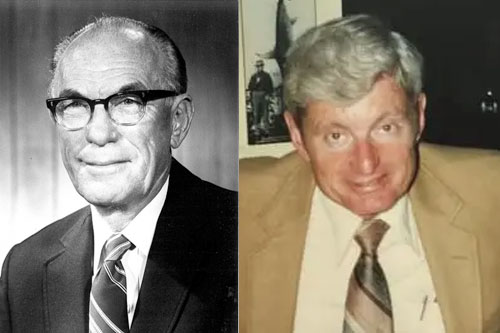
Clark Haines and Alan Johnson
"The idea for a classical music radio station in Dayton came from a small nucleus of people who just kept talking about it. 'Every time we would meet -- wherever -- someone would say, "Wouldn't it be great to have a classical music station in Dayton?"' Haines says. In December of 1980, a group of 30 met at Sinclair Community College to act on their idea. The small, fledgling non-profit group had little idea of what they were in for when Dayton Public Radio Inc. was formed, incorporated and Haines was elected president." ["At long last, public radio comes to Dayton," by Peggy Magill. Dayton Magazine (Dayton, Ohio). March/April, 1986. Page 10.]
"At that first meeting, after unanimous agreement that we wanted to pursue this, we each put $5 on the table to finance our Ohio non-profit incorporation," Lloyd Bryant recalled in 2025. He also had high praise for how Clark Haines guided the group. "If he had been in the military, he would have been a General Officer. No one ran a meeting like Clark did, or maintained his command of the big picture: all business, well-planned, concise, totally effective."
With the coming of the new year, the volunteer committee took important steps to turn their dream into reality. On January 6, 1981, the group was incorporated under the name Dayton Community Radio (and submitted a $25 filing fee to the Ohio Secretary of State). Ed Kuhns provided legal expertise to the fledgling organization. "I was involved when all we were was a paper station," he said. "We had no transmitters, no tower, no microphones, nothing. But we did have hope and the dream to acquire those things." ["WDPR Turns 15 This Month!" 3.]
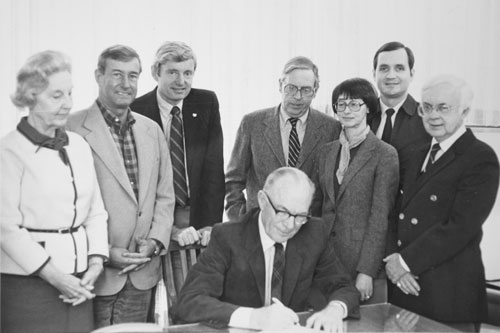
Clark Haines signs legal documents surrounded by Doris Spika, John Kohnle, Alan Johnson, Ed Kuhns, Sybil Pomeroy, Lloyd Bryant and Jim Bennett.
There were three major obstacles that had to be overcome in order to create a new public radio station. First, a massive amount of money was needed to acquire or build a studio, broadcast tower and transmitter. "If the station is to become a reality, the community is going to have to come up with some money. Bob Thomas, manager of system expansion for the public broadcasting corporation, said the startup costs for a station are about $250,000. Haines says Dayton Community Radio probably could raise $30,000 to $40,000 from individuals for its first year of operation. The other $100,000 to $160,000 would have to come from federal and foundation grants, corporate gifts, and donations of services and facilities. Haines thinks there's enough interest in the proposed station that the necessary financial backing will be obtained." ["If and Maybe . . . but Dayton plans to have public radio station next year," by Bob Schumacher. Journal Herald (Dayton, Ohio). November 4, 1981. Page 47.]
The second challenge was to obtain an FM radio frequency. Only a limited number of stations can operate within a given region, and the radio dial in Dayton was already packed. Without a frequency, Dayton Community Radio could have all the money it wanted and still not get on the air. In the spring of 1981, DCR began a systematic search for an available FM frequency, and started asking community members to donate to a radio station that didn't yet exist. "We have raised $1,500 for an extensive study to find an available channel with sufficient strength to serve the area properly. We are informed that the cost would be $3,500. In order to meet the cost we are in need of an additional $2,000 of 'seed money.' Following that we will need to capitalize a radio station and get into the difficult task of getting it on the air. We need broad community support and your continued interest is important." [Fundraising memo from Clark Haines to Friends of Dayton Community Radio. April 27, 1981.]
During this era, the Corporation for Public Broadcasting was eager to support the emergence of a new station. In the fall of 1981, a CPB representative spent two days in Dayton advising DCR about financing and building a new station, and submitting an initial application to the Federal Communications Commission. "Mr. Robert Thomas, Director of Expansion for the Corporation for Public Broadcasting, Washington, is visiting Dayton with the purpose of helping Dayton put a station on the air. The Corporation will pay all engineering costs, and other funds have been contributed privately to assist us in this endeavor." [Memo from Dayton Community Radio. October 1, 1981.]
A longshot scheme emerged for the new station to obtain an FM frequency: piggyback on the WYSO tower. Dayton Community Radio proposed to broadcast at 91.9 FM, even though WYSO was already at 91.3, and the FCC didn't allow two stations to be so close on the radio dial. Administrators at WYSO didn't rule out the idea, but they were cautious about this unproven approach. "The big problem facing the group, aside from raising the money needed to construct and operate a broadcasting facility, is that under the commission's rules protecting existing stations from interference, there is no frequency available in the Dayton market. With the help of the Corporation for Public Broadcasting, the Dayton group's application will seek a waiver of those rules. The corporation is interested in getting the commission to approve a test of the theory that under certain conditions, it's possible for stations to be closer together on the band than is now permitted without interfering with each other. Obviously, WYSO's cooperation is essential if such a plan is to work. So far, though, WYSO -- to its credit -- seems willing to cooperate as long as it is assured that the quality of its signal will not suffer. 'As it stands right now, we're not interested in hindering what they're doing at all,' new WYSO Station Manager Marvin Thordsen said." [Schumacher, 47.]
"The trickiest part about DCR's establishment revolves around the fact that there are currently no frequencies available for a new public station. The Corporation for Public Broadcasting is now wanting to try an experiment which would permit DCR to 'squeeze' itself onto the dial. This may be possible if WYSO and DCR are broadcasting signals which are identical . . . same strength, same direction, same height. What does it all mean? Well, no one knows yet, but I'll pass on any additional information as soon as it is available." ["OUTPUT: Report from the Manager." WYSO newsletter, c. December 1981.]
"I have always appreciated the friendliness and cooperation of WYSO in all this," said Lloyd Bryant in 2025. "For a while, we even had a member of our board of directors serving on WYSO's board and they assigned one of their people to serve with us. We also met with WGUC. These stations were totally welcoming to us and did not view us as a potential threat."
The third task DCR needed to accomplish was to determine the type of programming it would broadcast. A handwritten document from 1981 says, "Literally hundreds of Dayton area listeners have expressed a desire for a full-time classical music radio station. Dayton Community Radio plans to broadcast over 100 hours of classical music programming a week (averaging 14.5 hours of its 18-hour broadcast day)." [Dayton Community Radio programming objectives, c. late 1981.]
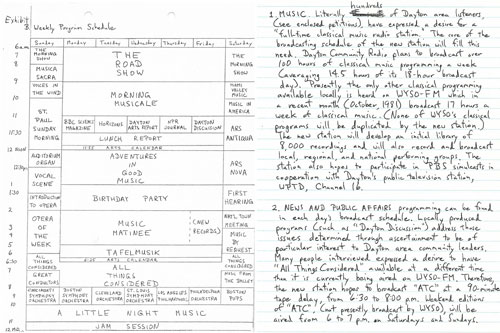
Dayton Community Radio's proposed broadcast schedule
Years before the station ever went on the air, someone sketched a proposed broadcast schedule on notebook paper. It includes classical music programs available nationally (like Adventures in Good Music with Karl Haas, Saint Paul Sunday and the Los Angeles Philharmonic), along with locally produced classical shows (Miami Valley Music, Great Conductors and Music from the Ballet). At 10pm on the schedule is A Little Night Music, but this document had been long forgotten by October 2022 when Samee Griffith began hosting a 10pm show with that same title on Discover Classical. Perhaps surprisingly, the proposed schedule also included jazz music, along with talk-heavy public affairs programs, like National Public Radio's All Things Considered and a local show called Dayton Discussion.
Early the following year, DCR took a significant step forward when it submitted an application to the FCC for the creation of a new public radio station in Dayton. The frequency was given as 91.9 FM, even though WYSO was already broadcasting at 91.3. Clark Haines signed the application as President of Dayton Community Radio. Ed Kuhns is listed as legal counsel and Lloyd Bryant a trustee. [Federal Communications Commission Application for Authority to Construct or Make Changes in a Noncommercial Educational TV, FM, or Standard Broadcast Station. January 5, 1982.]
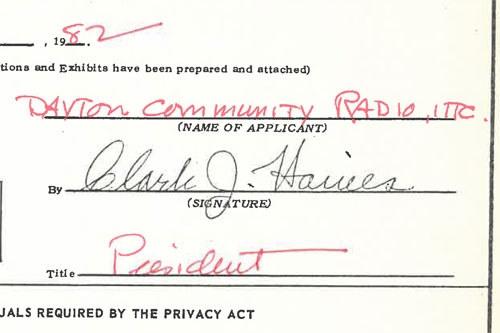
Clark Haines' signature on Dayton Community Radio's FCC application
In 1983, there was still no public radio station in Dayton, but important connections were made with two individuals who would later become closely associated with WDPR. During this period, Charles Wendelken-Wilson was the conductor of the Dayton Philharmonic Orchestra. In an interview recorded in 2005, Charles recalled how he first heard about the proposed station. "Way back in my memory in the early 1980s, there were rumors around about a public radio station in the happening. Then in 1983, the Philharmonic's 50th anniversary year, I remember Clark Haines and John Kohnle and I were about to go out to lunch. And Clark said, 'Do you mind if we stop at the lawyers? I have to sign some papers for Dayton Public Radio.' And that's the first time I heard the official name."
In 2005, Charles Wendelken-Wilson recalled the first time he heard about the station:
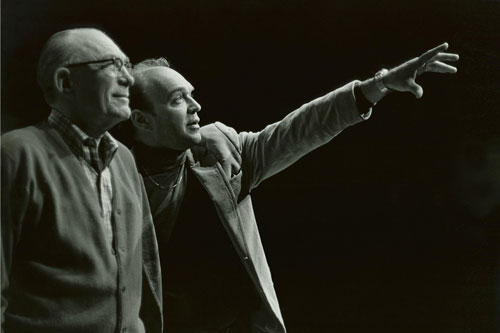
Clark Haines and Charles Wendelken-Wilson
Also in 1983, Lloyd Bryant became acquainted with Larry Coressel, who has been the morning host at Dayton Public Radio since 1987. In 2025, Lloyd recalled, "I was playing timpani with the church choir where his mother was a member in Springfield. And during a break, one of the ladies said, 'See that lady over there? Her son is in high school and he wants to be a classical music radio announcer.' And so I met her and later I met Larry, and I said, 'Well, we've got the new station starting in Dayton, and when we get ready to hire somebody I'll let you know.' I was really amazed to find a guy in high school who knew he wanted to be a classical music radio host."
In an interview recorded in 2005, Larry told a similar story from his perspective. "I was about 18 years old when I met a guy named Lloyd Bryant who told me all about his involvement with a group of people who were trying to start a radio station. The idea was to start a new classical music public radio station in the Dayton area, and I thought that sounded really cool, since I had always loved classical music, and I had often wondered why there wasn't already a classical music station in the Dayton and Springfield area. So I told Mr. Bryant that I'd love to get involved."
Records about the origin of the radio station are scarce, and there are no documents pertaining to the year 1984. In a conversation recorded in 2025, Lloyd Bryant said, "We weren't very good about keeping history early on, that's for sure. We were more interested in getting on the air and providing music."
Clark Haines and other Dayton-area music lovers began the task of creating a classical radio station in 1980, unaware of the years of struggle that would follow. "'It began a long period of hills and valleys -- days when the board felt that success was right around the comer, followed by days when it appeared all was lost,' Haines says." [Magill, 10.]
The hard work of the station's founders finally culminated in the year 1985. The idea of broadcasting at 91.9 FM was abandoned (along with the name Dayton Community Radio). Instead, Dayton Public Radio took a different approach to obtaining an FM radio frequency. "The first order was to find a frequency on the FM dial that no one else had. Extensive engineering studies were carried out. Finally, after three years, it was determined that no such frequency was available, and that it would be necessary to purchase a station if they were going to be successful." [Magill, 10.]
In an interview recorded in 2005, Lloyd Bryant said, "We had investigated any number of opportunities and possibilities, finally buying a station from a gentleman named Harold Parshall. He owned two small radio stations down on the left end of the dial with two different kinds of formats. He decided to sell us one of those."
In June 1985, Dayton Public Radio purchased WCXL at 89.5 FM and the call letters were changed to WDPR. The studios and offices were on the lower level of the Hills and Dales shopping center in Kettering. The facility was far from new, but the station had what it needed to go on the air. John Kohnle said in an interview in 2000, "We started with such humble beginnings in the basement of Hills and Dales shopping center. It was like a Rube Goldberg creation, working with whatever equipment we could get." ["WDPR Turns 15 This Month!" 5.]
Monday November 11, 1985, was chosen as the date for WDPR's first broadcast. Twenty years later, Lloyd Bryant recalled, "We were fortunate enough to get good publicity from the papers and the local broadcast folks. We had an outdoor press conference where we chatted about getting the license and about the plans to go on the air, and of course all of the early folks, like Clark Haines, who were involved in the station's beginnings were all there."
Jim Briggs was an announcer at the Dayton radio station WING. In an interview in 2000, he said, "When DPR went on the air, they held a big kick-off media event at the Arcade and I was the emcee. When I was asked to do the honors, I was glad to oblige. It really was a very big day for Dayton and the arts and very exciting to be a part of." ["WDPR Turns 15 This Month!" 4.]
Lloyd Bryant knew exactly what he wanted to play when the new station went on the air: Beethoven's monumental Symphony No. 9. In 2025, he said, "I was bound and determined that our first piece of music was going to be the Beethoven Ninth, because 'joyful, joyful,' you know. We were so happy to be on the air." Lloyd hoped to play it from a compact disc, but the recording he ordered didn't arrive in time. "So I went back to my library and I pulled out an LP that had never been played, and it's one that I still have. It's of a complete set of the nine with Kurt Sanderling and the Philharmonia Orchestra."
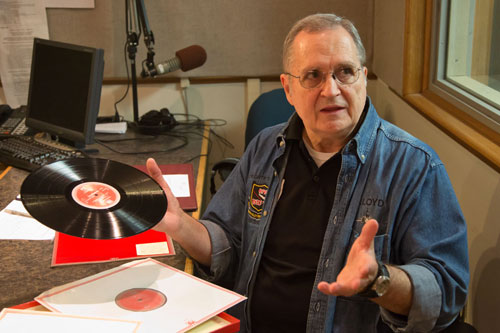
In 2015, Lloyd Bryant holds the Beethoven LP that he played on the day of WDPR's first broadcast.
WDPR's first broadcast studio had a couple of portable CD players, along with bulky turntables to play LPs, drawn from a substantial library of donated albums. "Since the station is being launched on a shoestring budget, the acquisition of a collection of classical recordings -- a gift from WHIO -- will provide the nucleus of a library. The problem now, admits Lloyd Bryant, program director, will be to have the records catalogued and to check their playing quality." [Krebs, 28.]
"As Bryant sits in the studio of the new station, he is surrounded by the usual standard equipment -- most of which was purchased with the station and some of which is his own -- and a record library of 1500, which was donated by WHIO ('in mint condition')." [Magill, 10.]
After all of the hard work and planning, WDPR's first broadcast was nearly disrupted by nature. "Its initial programs were broadcast at only 10 watts of power, as lightning had struck the transmitter in downtown Dayton just two nights before it went on the air." [Magill, 10.]
Lloyd Bryant remembered, "There was a bit of storminess happened that day, and the station, the transmitter, and the tower were downtown, up high in one of the local buildings, and we had a lightning strike just before we went on the air, which reduced our operating power to 10 watts. But I heard from two or three people who said, 'I was listening when you signed on.'"
Charles Wendelken-Wilson, conductor of the Dayton Philharmonic at the time, visited WDPR on that important day. In an interview recorded in 2005, he said, "The very first day it went on the air, I came down to see the studios in Hills and Dales, and there was no coffee machine. So the next day I went out and bought a Mr. Coffee. And I still think the radio station runs on the coffee machine."
Among the founders of Dayton Public Radio, Lloyd Bryant was the obvious choice to be the station's first announcer. He was the only person in the group with an FCC license, and had years of experience in radio and classical music hosting. "A large part of the quality at WDPR comes from Program Director Lloyd Bryant, who has the 'professional sound' Haines says they were looking for. Bryant has been in radio on and off since he was 14 years old." [Magill, 10.]
In 2025, Lloyd said, "At first, I was the only person on the air. I was already doing some classical programming, and I had been around it for a long time. I knew I never wanted to be a General Manager. That's the job I'd leave to other folks. I always just wanted to be on air."
WDPR's broadcast hours were limited, because it shared the 89.5 FM frequency with WDPS, the radio station of Dayton Public Schools. As a result, WDPR's debut occurred after the school day was over. Lloyd Bryant recalls: "We were scheduled to go on at 4:30, in our little studio down in the basement at Hills and Dales. And so, at 4:30 in the afternoon, I flipped on the mic switch and said, 'Good afternoon, ladies and gentlemen. This is Dayton Public Radio signing on the air for the first time.' I gave a little opening introduction. and started our first piece of music."
Looking back 40 years later, Lloyd said, "When we finally signed on the air someone casually mused, 'I wonder if we would have continued to pursue this if we had known it was going to take five years.' I completely believe we would have, that's how strongly we believed in it and wanted it to happen."
Imagine a store that sells hardware for part of the day and baby clothes the rest of the day. If you went there to buy a hammer and nails, you'd be frustrated if all you found were bibs and booties.
When WDPR began broadcasting on November 11, 1985, it was the culmination of years of dedicated effort, but the station still had enormous obstacles to overcome. The greatest challenge was that WDPR shared the 89.5 FM frequency with WDPS, the radio station of Dayton Public Schools, which played a much different style of music. Classical lovers were frustrated when they turned on their radios and heard Dr. Dre instead of Debussy.
Transforming WDPR into a full-time station was a top priority for Jim Eblin, the first general manager of Dayton Public Radio. There was no FM frequency available on the local radio dial, until the FCC tipped the first domino in a complex series of events. "Student broadcasters at Centerville High School aren't too happy these days. The Federal Communications Commission has knocked their radio station off the air. The FCC opened up the possibility of a new full-power FM station for the Dayton area by assigning frequency 92.1 to West Carrollton. Unfortunately, 92.1 is the same frequency on which the Centerville schools' WCWT has operated for the past seven years. At least two local groups have expressed interest in the new FM frequency. One of them is WDPR-FM, Dayton's classical music station. 'We would consider any alternative to our current frequency to get expanded broadcast hours,' said General Manager James Eblin." ["FCC expels student radio station," by Tom Hopkins. Dayton Daily News (Dayton, Ohio). April 6, 1986. Page 62.]
"WDPR board members are discussing the possibility of applying to the Federal Communications Commission for the new FM frequency 92.1. 'We are making a study of it,' [Clark] Haines said. 'If we go to 92.1, that would give us a 3,000-watt Grade A signal and give us better coverage.'" ["Classical WDPR may seek new spot on dial." Dayton Daily News (Dayton, Ohio). May 24, 1986. Page 34.]
Dayton Public Radio faced stiff competition because there were many organizations and individuals pursuing the FM frequency. "The battle for Dayton's new FM radio station is shaping up as a battle of Davids and Goliaths. Among the 11 parties who have applied for the new FM frequency 92.1 are some familiar names. They include three former general managers of Dayton radio stations, three former on-air personalities, operators of Dayton's classical music station, a local nightclub owner and even actor Dorian Harewood's brother. The station is allocated to West Carrollton, but will put a strong Grade A signal across the Dayton metropolitan area. WDPR-FM, the classical music station that went on the air last year, has only 230 watts and limited hours, sharing airtime with the Dayton public schools' WDPS. A new radio station is a rarity these days, with the dial already jammed." ["11 Parties on the Same Wavelength," by Tom Hopkins. Dayton Daily News (Dayton, Ohio). July 13, 1986. Pages 52 - 53.]
Ultimately, the 92.1 FM frequency was allotted to WROU, an urban contemporary station founded by Dayton educator and dancer Ro Nita Hawes-Saunders. WDPR's search for a full-time frequency continued.
At the fledgling station, much of the work was accomplished by people from the community who were willing to provide their services without pay. This included announcers whose voices became familiar on the radio, and others who performed office tasks and received little public recognition.
"WDPR and WYSO share a common bond -- volunteers. As public radio stations subject to grants and fundraising projects as major means of support, volunteers are the lifeblood of their operations. WDPR has a single full-time staffer, General Manager James E. Eblin, formerly general manager at WING-AM and Z-93 FM. Eblin's immediate goal is no more ambitious than wanting to combine the efforts of [Lloyd] Bryant as volunteer program director and Linda Nevin, coordinator, with the help of devotees 'to present quality product of which we can be proud.' And as Nevin points out, 'If it weren't for volunteers, we wouldn't be as far along as we are at this point. So far, we have 53 people helping.'" ["Volunteers are Busy Making Waves," by Jim Nichols. Dayton Daily News (Dayton, Ohio). March 2, 1986. Pages 53 and 58.]
"Dayton public radio is finally a reality. Led by a volunteer board of directors, a full-time station manager and part-time consultants in the areas of programming, volunteer recruitment and engineering, the new station went on the air November 11, 1985. Volunteers make up the rest of the much-needed manpower. Program hosts on the new station, other than Bryant, are volunteers. A number of volunteers are learning to run the board. 'There is no stereotype of the type of person who can help us,' says Linda Nevin, director of volunteers. Five women come in, each one day a week, to answer the phone, type and send out mailings. Another is cataloguing the record library. One man from Englewood brought his own brushes and drop cloths and came in and painted. Others are researching arts groups, civic organizations and corporations to put information about WDPR in their publications 'to let them know we exist and want their support,' Nevin says." ["At long last, public radio comes to Dayton," by Peggy Magill. Dayton Magazine (Dayton, Ohio). March/April, 1986. Pages 10 - 11.]
Lloyd Bryant was at the microphone when WDPR went on the air for the first time on November 11, 1985. Just a few weeks later, Don Vandenberg joined WDPR as a host on Fridays and Saturdays. Don began his radio career in Chicago in 1935, and had been an announcer at WYSO since 1982. In 1995, he said, "I was asked by Lloyd whether I would be interested in announcing on a new radio station in Dayton, as he liked the way I pronounced Ralph Vaughan Williams -- I hope among other things! He later on asked me what I thought of a fellow announcer at WYSO whom he was thinking of asking to come along with WDPR also. I told him that, in my opinion, an announcer by the name of Larry Coressel would be better at the job as he had a better voice and knew more about classical music -- so now we have Larry!"
Lloyd had already approached Larry Coressel about becoming a volunteer host, but he was busy with other commitments. In 2025, Larry recalled, "I couldn't because of my 'real jobs' at the time at the Clark County Public Library and as a camera and sound operator at the now defunct Channel 26 TV in Springfield. I was also volunteering about once a week at WYSO back then. I was finally able to spare some time in October of '86, and Lloyd put me on a couple of nights a week on WDPR."
The longest-running program on WDPR is The Intimate Guitar, hosted by Jim McCutcheon. In 2025, he described how he first became involved with the station. "I have taught at the University of Dayton since 1978 and while Richard Benedum was the chair [of the Music Department], he mentioned that some people were starting a classical FM station. I contacted Lloyd Bryant and Bill Combs and they were really welcoming! The Intimate Guitar was Thursday nights at 6:30 for an hour and I had to be at Peasant Stock Restaurant at 7:30 to start playing, so I was able to get the next announcer to come a little early and babysit the station while my final guitar works went out over the air. As I would pull into Peasant Stock's parking lot, I would hear myself saying goodbye."
Stuart Sebastian was the artistic director of Dayton Ballet in the 1980s. As WDPR grew, Lloyd Bryant reached out to people who might be willing to host a radio program. In 2025, he recalled, "I called Stuart Sebastian and said, 'Would you do a program for us of ballet music?' and he leaped in and did that." "Dayton Ballet director-choreographer Stuart Sebastian will premiere his new weekly radio program on WDPR-FM, 89.5 on the dial. The show is titled Shall We Dance? and will air from 6 to 7 p.m. Sundays. It will feature all kinds of music for dance." ["Dayton Ballet Prepares for Intermission," by Terry Morris. The Journal Herald (Dayton, Ohio). April 12, 1986.]
Larry Kensington hosted a jazz program on Saturday nights (using the name Sam Lawrence). In a 2005 interview, he recalled, "In 1986, I recorded a weekly jazz show for WDPR. I was working overnights full-time at WHIO, playing dentist's office music in the middle of the night. I heard about WDPR, I think I read something about it in the newspaper. I went there and asked, 'Is there anybody here doing a jazz show?' And when the folks running the station found out I was actually a radio professional already, they said, 'Sure, you want to do a jazz show, fine.'"
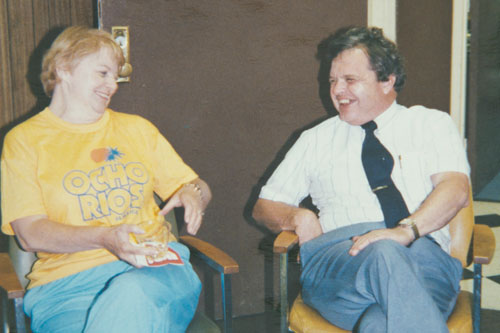
Grace Anne Drake and Roland Marcus
Years before WDPR went on the air, Clark Haines received a letter from a community member excited about the possibility of a classical music radio station in Dayton. "I believe you have been sent from heaven! For years I have wondered why a city the size of Dayton didn't have a classical music station. There's certainly a need for it. If there is anything at all that I can do to help with your project let me know!" [Letter from Grace Ann Drake to Clark Haines. March 30, 1981.] In the fall of 1986, Grace Ann Drake became an announcer at WDPR, hosting a program called Grace Notes on Thursday afternoons.
Roland Marcus, pastor of a church near WDPR's studio, became an announcer in 1986, hosting a program called Sunday Soundings. "Classical music has always come naturally to me. When I read in the paper that the station was largely staffed by volunteers, I volunteered to do anything from sweeping floors to stuffing envelopes. Being an announcer for WDPR has been such a source of personal growth for me." ["Personality Portrait: Roland Marcus," by Joy Nunn. Dayton Public Radio Keynotes. November/December 1987. Page 4.]
In July 1986, the inaugural issue of WDPR's program guide Keynotes included a list of volunteers, and Charles Knight's name was on it. His voice was rarely heard on the radio, but he helped behind the scenes. In 2025, Lloyd Bryant spoke highly of Charles' dedication. "From the start, he volunteered to do anything needed, except be on the air. He would purchase fluorescent light bulbs or paper towels and soap or take care of any other routine need with no desire for special recognition. He just possessed an endearing love for the station, the music, and what we were doing." Charles even volunteered to come to the WDPR studio to play prerecorded programs on Christmas Eve. Lloyd said, "I've still got the tapes I put together of programming to play during that Christmas Eve when I had to be away."
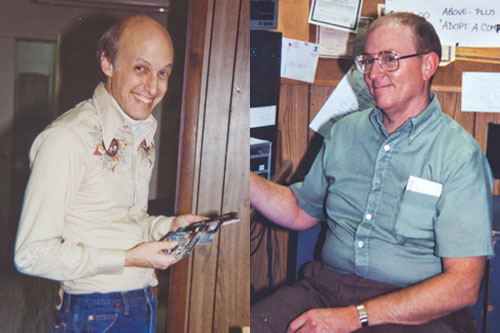
Jim McCutcheon and Charles Knight
Dayton Public Radio was constantly raising funds to cover both ongoing operating expenses and important technical improvements. Because the station was on the air for only part of the day, and its transmitter power was too low to reach the entire Dayton region, it was difficult for WDPR to increase listenership (and its pool of potential contributors). It was critical to enhance the quality of the broadcast, since people were unlikely to donate to a station they couldn't hear.
"Achieving both monetary and programming goals is somewhat of a Catch-22 situation. In order to attract listener contributions, WDPR's broadcast quality must be high. With present technical insufficiencies, such quality is difficult to achieve." ["WDPR's Future is Bright," by Jane Dikeman. Dayton Public Radio Keynotes. September/October 1986. Page 3.]
"Technical insufficiencies represent a major obstacle to WDPR's continued growth and prosperity because listeners are unable to receive a clear, stereo signal. The station must improve broadcast quality if it expects listeners to financially support its operations. Dayton Public Radio proposes to remove these obstacles by undertaking a $242,259 two-year capital campaign to finance a new transmitter and antenna, master control room, and production room. With these major obstacles removed, WDPR will be able to generate ongoing operating support from its listenership." [Dayton Public Radio Capital Campaign Narrative. c. 1986.]
At about this time, Bill Combs replaced Jim Eblin as general manager of WDPR. "Bill comes to us from WGUC in Cincinnati, where he was director of development. 'WDPR has the most progressive, forward-thinking board of directors I've ever worked with, and the quality and diversity of the programming is outstanding. It's an exciting atmosphere in which to work.'" ["Introducing Bill Combs." Dayton Public Radio Keynotes. July/August 1986. Page 1.]
In 2025, Bill spoke about the many challenges he faced when he assumed the role. "We were broadcasting at 200 watts. We were on the air 12 hours a day. We were sharing time. When I came in for the interview with Ed Kuhns, vice president of the Board of Trustees, we had discussions about where I believed we needed to go. They asked me at the end, 'How long is this going to take you?' I said, 'About a year.' Thirteen years later, it finally came to fruition."
At the beginning of 1987, WDPR expanded its broadcast hours, resulting in changes to the program schedule and announcer lineup. "FOR THE FIRST TIME, LISTENERS WILL BE ABLE TO HEAR CLASSICAL MUSIC IN THE MORNINGS AND AFTERNOONS ON THEIR WAY TO AND FROM WORK!" ["Letter from the General Manager," by Bill Combs. Dayton Public Radio Keynotes. January/February 1987. Page 1.]
Larry Coressel moved from Thursday nights to an early morning show (which he's still hosting decades later). In an interview recorded in 2005, Larry said, "One day, much to my surprise, Bill Combs gave me a call and asked if I wanted to launch the new morning drive time program. That meant getting up at about four o'clock in the morning and going on the air at 6. Well, I immediately said 'Yes,' and then I asked, 'Are you going to pay me?' Bill laughed and said, 'Well, sure, we'll pay you.' And I began the first Monday of '87, six o'clock, dark and early, with Edvard Grieg's Morning from Peer Gynt, and I've been here ever since."
A few months later, Adam Alonzo began to host a Saturday evening program on WDPR. In 1995, he recalled, "I read an article about a public radio station in Dayton which was expanding its broadcast day and was in need of volunteer announcers. I arranged a meeting and audition. The demo tape was easy, but knowledge of classical music was my weak point. I met [afternoon host] Paul Lane, who had me read a list of composers and musical works, and we both knew I did a poor job (I thought Ralph Vaughan Williams was a trick question). I began my Saturday night shift in March 1987. Operating the board and turntables was not difficult for me, but I was nervous about what to play and what to say. I didn't tell anybody that I had this job because of my lack of confidence. My dad found out about it from someone he worked with."
Robert Weisman, Chair of the Biochemistry Department at Wright State University, joined WDPR as a volunteer announcer in the spring of 1987. "I was listening to the station and heard that it needed volunteers. Since I have a great interest in classical music, I called. I once held informal classes for friends introducing them to classical music." ["Personality Portrait: Robert Weisman," by Joy Nunn. Dayton Public Radio Keynotes. November/December 1988. Page 4.] Bob's role changed over time, but he specialized in opera and vocal music programs. In 1995 he said, "The nice thing was that I could play recordings of the great singers of our time."
In an interview recorded in 2005, Paul Spiegel recalled how he became involved with WDPR. "There was an article in the Dayton paper about a new public radio station in town. I had no real thoughts about getting into radio. However, considering my 32 years of professional orchestral playing, I thought that perhaps I knew the repertoire and the pronunciation well enough that I could pass. I went to the basement of the Hills and Dale shopping center and gave several presentations to the tape recorder. It was later on listened to by the staff, and they deemed that it was okay and that I could be put on as a volunteer announcer."
Charles Wendelken-Wilson was a well-known figure in the local performing arts scene, having served as conductor of the Dayton Philharmonic Orchestra from 1975 to 1987. Soon afterward, he became the first Music Director of WDPR. "Charles has more than 10 years experience in communicating with Greater Dayton classical music lovers. We are pleased to welcome Charles, and look forward to his contributions to quality fine arts radio." [Keynotes. January/February 1987. Page 1.]
"Initially, Charles' main motive for supporting the station was his desire for the Dayton Philharmonic concerts to be broadcast. Then, as the station grew and reached its first anniversary, the management saw the need to tighten up its programming and Charles was a logical choice to provide that much needed single point of view." ["Music Director Dreams of Full-Time Station," by Susan Eklund-Leen. Dayton Public Radio Keynotes. September/October 1987. Page 2.]
By the fall of 1987, Anne Brown joined the staff of WDPR as Development Director. "Anne began part-time and now works full-time at the station doing everything from membership drives and special events to recruiting volunteers and vacuuming the studio. You name it, Anne has had a helping hand in just about everything." ["Personality Portrait," by Joy Nunn. Dayton Public Radio Keynotes. November 1989. Pages 25 - 26.]
By 1988, WDPR had yet to hold an on-air pledge drive, but the station undertook a creative fundraiser in February. Listeners were invited to celebrate Valentine's Day evening at home while enjoying classical music on the radio and a gift bag with poetry books, chocolates, stuffed animals, balloons and more.
"'We decided that this was a good time to have a fundraiser for the station,' says Susan Sauer. 'As people's lives get more hectic, cocooning seems to be a current trend. So we decided to have a no-party party.' On Feb. 14, from 7 to 11 p.m., Dayton's only fine arts public radio station will program an evening of light classical music. Charles Wendelken-Wilson and Lloyd Bryant will program and host the special night. The Valentine gift bags will contain an assortment of goodies and are priced at $25, $50 and $100." ["Celebrating Valentine's Day is Music to WDPR's Ears," by Meredith Moss. Dayton Daily News (Dayton, Ohio). January 24, 1988. Page 65.]
Also in 1988, WDPR took a major step forward by increasing transmitter power and upgrading its signal from monaural to stereo. "WDPR-FM has received Federal Communications Commission approval to increase power from 200 to 6,000 watts. This is significant because WDPR will now be heard throughout Montgomery County. In addition, stereo broadcasts will be possible." ["Dear Listener," by Bill Combs. Dayton Public Radio Keynotes. July/August 1988. Page 1.]
"Beethoven will be bolder. No static for Strauss in the suburbs. WDPR-FM is boosting its power and adding stereo sound by the end of the month. Increasing its output from 200 watts to 6,000, the public radio station will reach listeners all over the Miami Valley, not just Dayton. 'Our transmitter is in place and a 70-foot tower is going up on the Miami Valley Tower next week,' [General Manager Bill] Combs says. The power increase and added stereo is only the first step. Expanded weekend hours will be next, Combs says." ["Public radio station to reach out for larger audience," by Tim Fish. Dayton Daily News (Dayton, Ohio). December 11, 1988. Page 37.]
Greater transmission power brought WDPR more listeners and potential donors, so the time was right for the station's first on-air fundraiser: May 15 - 21, 1989. "These are fine times for WDPR-FM, Dayton's fine arts public radio station. First the station boosted its power from 200 to 6,000 watts so it could reach more of the Miami Valley. Now WDPR wants to expand its broadcasting schedule from 66 to 132 hours a week. To do that, WDPR needs money, and the station has launched a fundraising campaign. The goal, general manager William L. Combs says, is $20,000. As soon as the money is in hand, the station's hours will be doubled, he says." ["WDPR seeks funds to double broadcast hours," by Bob Batz. Dayton Daily News (Dayton, Ohio). May 3, 1989. Page 36.]
"This month we will hold our first ever on-air fundraising campaign, with a goal of raising $20,000 in listener support. When this goal has been achieved, our broadcast hours will be expanded immediately. We are receiving calls daily from delighted listeners who have just discovered us. These calls are from places previously unreached by our old signal. The power increase has enabled us to bring fine arts programming to a whole new circle of listeners." ["WDPR News," by Anne Brown. Dayton Public Radio Keynotes. May 1989. Page 5.]
In an article published in 2000, Bill Combs recalled the experience. "During our first fundraiser, we had no idea what we were going to raise. We were using phone banks at Reynolds & Reynolds and faxing back and forth pledge counts. I went on the air for the first time -- and that was intimidating. It was scary, exciting, at times goofy, never dull -- and then it was successful!" ["WDPR Turns 15 This Month!" Dayton Public Radio Keynotes. November 2000. Page 6.]
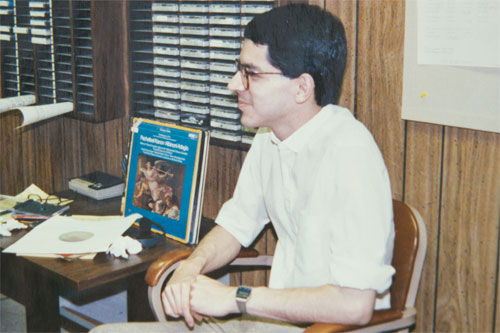
Adam Alonzo ready to play Pachelbel's Canon from LP during WDPR's first pledge drive
"Campaign '89 was overwhelmingly successful! Between the last week of April and May 21st, WDPR more than doubled the number of Friends of WDPR. Our present membership stands at over 1,500 listeners. Our $20,000 goal was exceeded by almost $7,000. Our administrative staff of two people is swamped with the paperwork associated with Campaign '89. New and old friends must be invoiced and added to our mailing list." ["State of the Arts," by Bill Combs. Dayton Public Radio Keynotes. July 1989. Pages 1 and 4.]
Jenny Paxson volunteered to help with the post-campaign paperwork, and ended up staying longer than planned. In 2025, she said, "After the first on-air membership campaign, I visited the station to help Anne Brown mail thank-you letters and gifts to new members. By the time the next campaign came around, Anne and Bill Combs asked if I could help them out as a temp employee for six weeks. I eagerly agreed. It was exhausting but so much fun. I even went on air with the real announcers. After the six weeks were over, I was to start a new job, but my heart was still at WDPR. I asked Bill if I could come back, and he must have found the funding for another employee, because he readily agreed. I was given the title of Membership Supervisor."
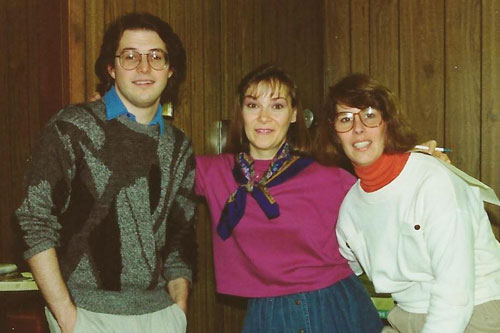
Larry Coressel, Jenny Paxson and Anne Brown
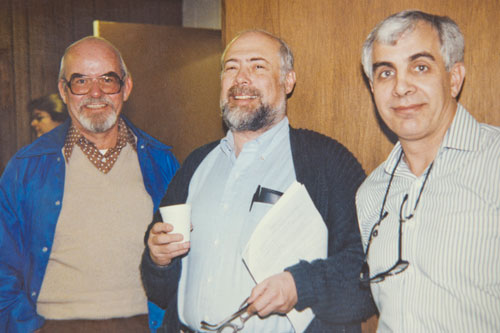
Paul Spiegel, Bob Weisman and Hank Cates
Since 1972, Hank Cates had been an announcer at WYSO, where he hosted broadcasts of the Metropolitan Opera. When that station stopped carrying opera in the 1988/1989 season, the program found its way to WDPR, with Hank at the microphone. "I called Bill (Combs, WDPR's General Manager) and said, 'Do you want to carry the Met?' He said, 'Sure,' and I said, 'Well, I come with it.'" ["Personality Portrait: Hank Cates," by Jenny Paxson. Dayton Public Radio Keynotes. September 1991. Page 28.]
In 2005, Hank Cates described how he became involved with the station:
In the spring of 1989, Ron Davidson, a retired Air Force officer, became the afternoon host at WDPR. "There is good reason for that smooth, professional sound that comes from Ron Davidson. His extensive experience with radio began at the early age of 16, when he had a local program while still in high school." ["Personality Portrait," by Joy Nunn. Dayton Public Radio Keynotes. June 1989. Page 24.] "The opportunity to announce classical music programs for WDPR is a pinnacle of my life, and I feel really fortunate to have such a rare opportunity. Each of us chooses the music we play, and what to say about the music. Our freedom is virtually complete, and out of this grows a diversity of programming that benefits the listener." ["WDPR News," by Ron Davidson. Dayton Public Radio Keynotes. July 1990. Page 5.]
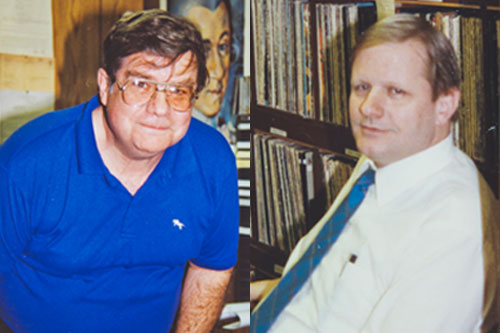
Ron Davidson and Bill Combs
Following the success of WDPR's first pledge drive, the station fulfilled the promise made to listeners and increased its broadcast hours. "Last week WDPR officials doubled the broadcast hours of the 6,000-watt classical music station. WDPR, previously limited to 64 1/2 hours each week, is now on the air for more than 130 hours. Not bad for a station that went on the air less than four years ago with 200 watts, a handful of supporters and a broadcast day that lasted only a few hours. WDPR's filling the new-found air time between 10 p.m. and 6 a.m. with satellite feeds. Eventually, the station will offer local programming during those hours." ["For expanding WDPR-FM, it's truly been a classical gas," by Bob Batz. Dayton Daily News (Dayton, Ohio). September 24, 1989. Pages 33 - 34.]
Unlike public radio stations that are affiliated with a university or television station, WDPR is completely independent and relies on financial support from listeners to keep broadcasting. On-air pledge drives in the spring and fall were initiated in 1989 and continue to this day. The fall 1989 campaign exceeded its goal and raised more than $24,000, of which $865 was allocated to purchase recordings for the station's music library (which was mostly comprised of donated LPs and a small number of CDs). In 1990, WDPR organized another Be Our Valentine fundraiser and held a successful spring pledge drive.
"WDPR had its last fundraiser May 14 - 18. Dubbed 'Campaign 90,' it exceeded its $30,000 goal by $3,185, according to William Combs, the station's general manager. 'One reason we did so well is that we're still a relatively young station and new people are discovering us every day,' he said. 'The money provided by our listeners directly supports the programs they hear. Without our listeners, we wouldn't be able to make it.'" ["Fund-raisers: they're matters of currency urgency," by Bob Batz. Dayton Daily News (Dayton, Ohio). July 1, 1990. Pages 30 and 31.]
The Corporation for Public Broadcasting provided funding to radio and television stations that met certain criteria, but WDPR did not qualify. "The station has achieved each of the qualifying criteria with one exception. CPB mandates that public radio stations broadcast a minimum of 18 hours daily. WDPR can only broadcast 16.75 because of its time sharing agreement with the Dayton Public Schools. Listener contributions remain the single most important source of funds for WDPR. Yet, it is clear that CPB funding could make a critical difference in the quality of service that WDPR provides." ["Federal Funding for WDPR?" by Bill Combs. Dayton Public Radio Keynotes. June 1990. Pages 5 and 27.]
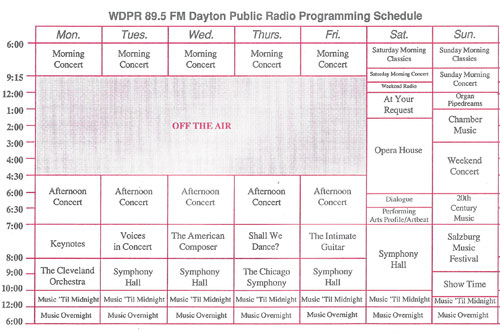
WDPR's program schedule from December 1990
WDPR's weekly program schedule showed all of the hours it was OFF THE AIR because it had to yield the 89.5 FM frequency to WDPS. Both stations were eager to break free of this time sharing arrangement. "At 89.5 FM, there isn't room for both WDPS, operated by the Dayton City School District, and WDPR, run by Dayton Public Radio Inc. School officials are looking for another spot on the FM dial and hoping to find one where the district can broadcast 24 hours a day. Dale White, supervisor of library and media services for the Dayton schools, said, 'If all the conditions were satisfied, we could be looking at anywhere from six months to three years.' The move was WDPR's idea, White said, because the station wants to extend its broadcast day. White said WDPR has offered to help the district find another frequency, which seems likely to be one of the less-powerful 10-watt frequencies available in the area. That's fine with the school district, as long as the new frequency can reach all the houses in Montgomery County and not be pushed off the air by more powerful stations." ["Do change that dial, schools say," by Scipio Thomas. Dayton Daily News (Dayton, Ohio). September 19, 1989. Page 5.]
Kenneth Kohlenberg was a member of the music faculty and director of bands at Sinclair Community College. He said, "We were having a brainstorming session at a rehearsal looking for ideas on how to promote the bands and someone said, 'You should go on WDPR like Jim McCutcheon.' I thought it sounded like a good idea. I want to make people aware that there is a lot of great serious music written for bands." ["Personality Profile: Ken Kohlenberg," by Jenny Paxson. Dayton Public Radio Keynotes. October 1991. Pages 27.] In January 1990, Ken began as a volunteer announcer on Friday nights, and he appears in a group photo taken at WDPR's fifth birthday celebration in November of that year.
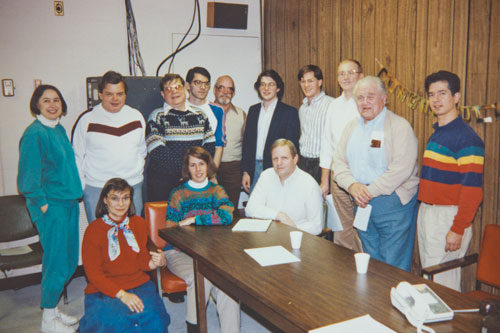
WDPR's fifth birthday in November 1990. Front: Jenny Paxson, Anne Brown, Bill Combs. Back: Susan Sauer, Roland Marcus, Ron Davidson, Adam Alonzo, Paul Spiegel, Larry Coressel, Michael Weiser, Charles Knight, Don Vandenberg, Ken Kohlenberg.
There's More to the Story
The years 1986 to 1990 were full of expansion and improvement for WDPR, but the station had yet to attain its own full-time frequency. In the years ahead, that challenge was overcome, and the station added new staff, studios, announcers and programs. Learn more in future installments.This narrative was written by Adam Alonzo, with assistance from volunteers Jenny Paxson, Sam Dodson and Mike Kreutzer.